Visitors to Beaumaris would be forgiven for thinking that its serene nature has always been the canvas under which it lies. For those interested, it has a rich past that betrays this and is in complete juxtaposition to the peace it offers visitors now.
History of Beaumaris
The Norman name ‘beau marais’, meaning ‘fair marsh’, was chosen by Edward I for the last of his ‘Iron ring’ of castles. The castle began to be constructed in 1295 in his bid to control the Welsh. Beaumaris Castle is a World Heritage Site and justifiably attracts many visitors each year. Beaumaris has a history that stretches far beyond 1295 by 1,235 years and involves one of the most brutal assaults on the British Isles.
Druidism and natural resources of Anglesey
During this time, Druidism was a force upon the Island of Ynys Mon. The known tribes including the Ordovices and Deceangli exploited the island of natural resources, such as copper, gold, tin, lead and silver. The rich farmland and excellent fishing that strengthened the islands bounty of natural resources attracted the mighty Roman Empire.
Menai Straits
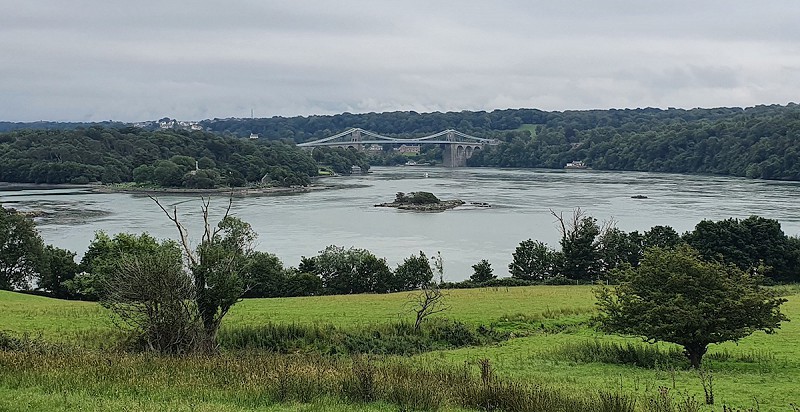
Following the Roman invasion of Britain in CE43, during the reign of Claudius, (Great, Great, Grand Nephew of Julius Caesar) the Romans invaded Wales in CE48 and later in CE60 invaded Anglesey. The invasion of Anglesey occurred across the Menai Straits, just at the bottom of the road where Ty Coed stands.
Using small flat bottomed boats protected by Ballistae and Onagers (types of catapult) stones and flaming missiles, the Romans crossed the Menai Straits to invade Anglesey. The scene would have been in stark comparison to the wonder and tranquillity of Beaumaris today. Druids dressed in black would have been screaming at the horror of the impending combat with the Romans, as horses and Roman cavalry swam and came ashore using the gentle slopes of the Beaumaris beaches.
Segontium
During your stay at TY Coed, whilst you meander through the town and its many attractions, picture the scene. For those whose interest extends further the Romans settled in Anglesey, making a camp made at Llanfairisgaer nr Caernarfon. A trip to Segontium, 13 miles from Ty Coed will provide a 1st century Roman fort and museum. Stones from the fort were used by Edward I to build nearby Caernarfon Castle.
